
You're on a call with a salesperson, designer, or project manager, and suddenly you're lost. They mention “installing workstations, HAT, and soft seating in the collaboration area,” and you find yourself nodding along while mentally scrambling to decode what any of that actually means. If this sounds familiar, you’re definitely not alone.
The workplace and office furniture industry is full of jargon, acronyms, and insider shorthand. While these terms help professionals communicate efficiently, they often leave clients confused and trying to catch up. And that confusion can create real problems—miscommunication, project delays, incorrect orders, and even unexpected costs.
That’s exactly why we created this guide: to break down the most common office design and office furniture terms you’ll hear during a project. These definitions come straight from real conversations our sales and project teams have with clients every day.
Understanding this language isn’t just about sounding knowledgeable. It helps you communicate clearly, make confident decisions, avoid costly mistakes, and get more value from your workplace design or office furniture budget.
(Feel free to bookmark this for easy reference—and thank us later 😉.)
Why Learning Workplace Jargon Saves Time and Money
Understanding the terminology used in office design and workplace projects helps you:
|
Approve Plans Faster No more back-and-forth just to clarify layout terms or spec sheets. |
Order With Accuracy Avoid costly rework by understanding key differences (e.g., workstation vs. touchdown station).
|
Reduce Project Delays Shared language = aligned teams, from designers to installers. |
|
Prevent Miscommunication For example, misunderstanding “D&I” may lead you to think only delivery is included — but installation is part of the service too. |
Streamline Moves & Relocations Knowing terms like Relo, Dispo, and Decom helps avoid confusion and last-minute surprises. |
Maximize Your Project Budget Clear definitions allow you to make faster, smarter decisions that prevent unnecessary expenses. |
Below is a client-friendly workplace glossary curated directly from the insights of our sales team, designers, and project managers. While we can't cover every term in the industry, we've focused on the ones you're most likely to hear during your project.
Office Furniture Terms
| IndustryTerm | What Clients Usually Say | What It Means and Why it Matters |
| Workstation |
Cubicle |
|
| Touchdown Workstation |
Hot desk, hoteling desk |
|
| Pedestal/Ped | File cabinet, under-desk drawers |
|
| Credenza | Cabinet, sideboard, storage behind the desk |
|
| Task Chair | Office Chair |
|
| Guest chair | Visitor Chair |
|
| Soft Seating | Sofa, Couch, Lounge chair |
|
| HAT (Height-adjustable table) | Standing desk |
|
Style & Design Terms (Often Confusing!)
| IndustryTerm | What Clients Usually Say | What It Means and Why it Matters |
| Curvilinear, Rectilinear |
Useful in describing space, concept, furniture design |
|
| Resimercial |
Residential look, commercial quality |
|
| Craft | Handmade, original details, natural materials, artisanal |
|
|
Biophilic Design |
Integration of natural elements into indoor public spaces. |
|
| Cohesion, Transition, Contrast, Texture | Used in describing design concept, palette |
|
| Smart Design | Both software and principals |
|
| Soft Architecture | Using flexible, adaptable products to create space divisions and privacy |
|
| Resident vs. Free | Occupied or open stations/offices |
|
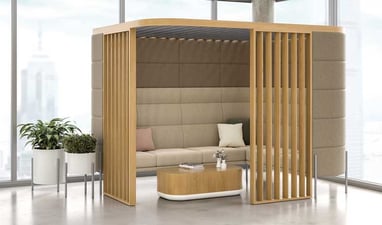
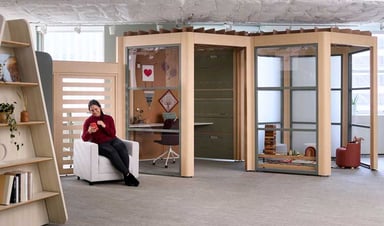
Soft architecture solutions featuring OFS's Obeya and Arcadia's LineUp.
Collaboration and Meeting Spaces Terms
| IndustryTerm | What Clients Usually Say | What It Means and Why it Matters |
| Huddle room | Small meeting room |
|
| Common Area | Space to hang out, chat |
|
| Collaboration Area | Casual area for small meetings w/ 4 – 8 people |
|
| Break Away Area | Place to get away from desk to make a call or check messages |
|
| Cafe/Employee Lounge | Enhanced break room |
|
Logistics, Moving & Installation Terms
| IndustryTerm | What Clients Usually Say | What It Means and Why it Matters |
| D&I | Delivery & Installation |
|
| Relo (Relocation) | Moving |
|
| Dispo (Disposition) |
Removal and Recycle |
|
|
Decom (Decommission) |
Removing everything out the office/suite |
|
|
Speed Pack |
Large box without a top |
|
| E-Crate | Mid-sized plastic box, built to stack 4-high on top of wheels |
|
Quick Guide on How to Get Familiar in Workplace Terms
- Ask for visuals in proposal: most terms become clear when paired with images
- Request labeled floorplans
- Use vendors who explain terms clearly and transparently
- Encourage your team to ask early questions
Before You Go
While you won’t remember everything in one sitting—and you’ll surely encounter terms not listed here (feel free to drop them in the comments, and we’ll let you know what they mean)—learning these basics will make you more informed, improve communication, speed up turnaround times, support better decisions, and help you achieve stronger results.
So whether you’re reconfiguring your space, planning a move, or simply trying to learn the terminology, speaking the same language helps you, your team, and our team work better together.
Need help navigating your next office project or clarifying a jargon term? Our experts are here to guide you. Get in touch >
Contributors:
- Rebecca Beauchamp – Senior Designer / Account Manager
- Tracy Marts – Senior Designer
- Shamaree Wilson – Project Manager